Deep Dive Peptides, region by region
Semax, Selank and the places their effects were measured. The closer I look, the harder it gets to talk about “the brain” as a single thing.
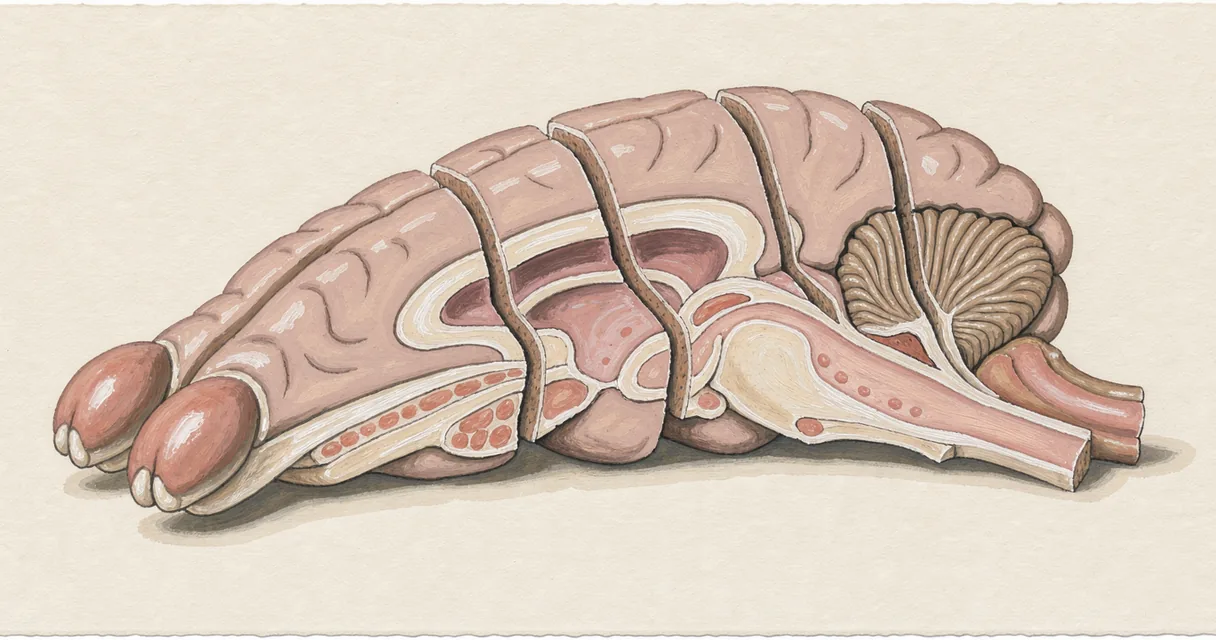
NGF in the hippocampus and frontal cortex
In a 2007 experiment in male Wistar rats, Semax increased NGF gene expression in the hippocampus and decreased it in the frontal cortex. Same compound. Different regions. Opposite directions. The rats had received a single intranasal administration; the researchers were measuring molecular changes in tissue.
NGF is nerve growth factor, one of the proteins that helps certain nerve cells survive. Gene expression measures the activity of the instructions for making a protein. That puts a useful distance between this finding and the much larger claim that something improves thinking.
I welcome that inconvenient decrease. A tidy account of Semax as a general growth-factor booster has to leave out the decrease. To me, that decrease deserves as much space as the increase: it makes the biological question more interesting and the popular slogan less convincing.
“Deep dive” starts here, with the part of the result that disappears when the brain region gets dropped from the sentence.
BDNF in rat tissue
BDNF, brain-derived neurotrophic factor, appears throughout both compounds’ research. It is a nerve-supporting protein, and its name can make very different experiments sound interchangeable.
In a separate Semax study, BDNF protein rose in the rat basal forebrain at 3 hours, while the cerebellum showed no such rise. The Selank hippocampus paper examined BDNF expression in rats. Each result has a location, a measurement and an animal attached.
I’m content to stay with a local change even when it leaves the contest between peptides unresolved. The Semax plates move from brain regions to injured tissue; Selank research follows cortical genes, anxious behavior and immune signaling. The overlap is real, but each experiment asks its own question.
Peptide names and search results
A peptide is a short chain of amino acids, the same building blocks used in proteins. Semax and Selank are synthetic peptides with different starting sequences; the names identify the compounds discussed here.
Searches such as “peptidic peptides,” “tides peptides” or “D peptides” can leave the chemical identity vague. Deep Dive Peptides is the name of this reading site. The source list concerns Semax and Selank, rather than every substance that appears under a broad peptide query.
I’d pin down the molecule before taking comfort in a category. Even a familiar name followed by “amidate” needs its own evidence before the original compound’s findings can be carried across. The comparison takes up those variant and alternative searches.
Questions beyond the tissue sample
Most of these detailed findings come from rats, mice or laboratory assays. The human literature is limited and concentrated in Russian research groups. I’d welcome broader replication, especially work that connects a precisely measured tissue change with a useful, lasting human outcome.
Community accounts describe clearer thinking or less worry, along with tiredness, headaches and nasal irritation. These are anecdotal reports, not clinical evidence. They explain the interest; they leave the cause of any change unresolved.
Neither Semax nor Selank has FDA or EMA approval. Research-labelled material is intended for laboratory work, with identity, purity and contamination concerns separate from the published biology. Long-term human safety remains unsettled. The questions page covers these gaps, foreign registration and prescription distinctions without turning animal findings into instructions for personal use.
Semax: regional findings
Hippocampus, frontal cortex and basal forebrain; then the injured tissue behind the memory claims.
Open Semax ›Selank: cortex and immune signals
GABA-related genes, stressed rats and the blood measurements in a small human study.
Open Selank ›